If you’ve ever spent time comparing cars, chances are you’ve heard someone ask: “Who makes the transmission?” In fact, many consumers take comfort when the answer is “Aisin.” Known for its reliability, durability, and precision engineering, Aisin transmissions are a silent endorsement for quality vehicles worldwide. While enthusiasts often associate Aisin with Toyota—its parent company—few pause to ask a deeper question: How did Aisin come to dominate the global transmission market?
The answer is fascinating, tracing back not only to Toyota’s rise but also to wartime factories, mergers, and relentless innovation. Today, Aisin is more than a supplier—it’s a crucial backbone of modern automotive technology. Understanding Aisin is not just trivia for gearheads; it’s a lesson in industrial transformation, global supply chains, and the Japanese model of steady, quiet excellence.
From Fighter Planes to Gearboxes: A Wartime Origin
Aisin’s story begins in the 1940s, during Japan’s wartime industrial mobilization. In 1943, Toyota teamed up with Kawasaki Aircraft to establish a factory for aircraft engines called Tokai Aircraft Industries. Meanwhile, another company, Toshin Aircraft, was manufacturing airplane components.
When Japan surrendered in 1945, both companies faced collapse. To survive, Tokai Aircraft rebranded as Aichi Kogyo, shifting to sewing machines and automotive clutches. Toshin Aircraft, on the other hand, became Shinkawa Kogyo, producing oil pumps, door locks, and jacks.
Interestingly, Aichi’s sewing machine venture reflected Toyota’s roots—before automobiles, Toyota had built its fortune on textile machinery. Both Aichi Kogyo and Shinkawa Kogyo gradually expanded into automotive components. By the 1960s, they were producing semi-automatic transmissions, pistons, and intake manifolds.
In 1965, the two firms merged, forming Aisin Seiki Co., Ltd., the foundation of today’s Aisin Corporation. Even the name “Aisin” came from combining AIchi Kogyo and Shinkawa Kogyo.
Aisin-Warner: A Strategic Global Partnership
In 1969, Aisin formed a joint venture with BorgWarner, an American drivetrain supplier, establishing Aisin-Warner (AW). This partnership was pivotal: it exposed Aisin to global transmission technologies and markets. Together, they developed AT (automatic transmission) units, and Aisin soon became the leading supplier of these systems in Japan.
During the 1970s and 1980s, Aisin rolled out numerous “world’s firsts,” including a four-speed automatic transmission with overdrive and Japan’s first sunroof system. The company also dabbled in “unrelated” businesses—from beds to fishing equipment to bidet toilets—reflecting the Japanese postwar spirit of diversification.
By 1987, BorgWarner divested its stake, and Aisin fully absorbed the AW division. This became Aisin AW, which went on to dominate the global automatic transmission market.
Consolidation and the Rise of Aisin Corporation
The 1990s and 2000s marked further specialization. In 1991, Aisin spun off its manual transmission division into Aisin AI, while Aisin AW focused on automatics. Both divisions innovated aggressively, creating reliable products that won contracts not only with Toyota but also with global giants such as Volkswagen, Volvo, BMW, and Chrysler.
By 2019, Aisin AI merged back into Aisin AW, unifying its transmission business. And in 2021, Aisin Seiki officially became Aisin Corporation, consolidating its subsidiaries and streamlining its global identity.
This constant reshaping of internal structure may look chaotic, but in reality, it reflects Aisin’s pragmatic, long-term approach—adapting to industry shifts without ever losing its core competency: drivetrain excellence.
What Aisin Makes Today
When people hear “Aisin,” they think “transmissions.” That’s true, but it’s only part of the story. Aisin’s portfolio spans:
- Automatic Transmissions (AT): Used in Toyota, Lexus, Volvo, Ford, and more.
- Hybrid and EV Components: Including eAxles, electric drive units, and gear reducers.
- Engine Components: Oil pumps, water pumps, pistons, manifolds.
- Body Systems: Door frames, locks, and sunroofs.
- Comfort & Lifestyle Products: From home-use bidets to mobility aids.
The diversity ensures resilience. Even if automotive demand shifts—say from ICE (internal combustion engines) to EVs—Aisin remains relevant.
Technology Highlights: The Backbone of Japanese Transmissions
Aisin’s reputation rests on both reliability and innovation. A few technologies illustrate this:
High-Efficiency Automatic Transmissions
Aisin pioneered compact, efficient automatic gearboxes that became the default choice for Toyota and many European automakers. Their units strike a balance between smoothness, fuel efficiency, and durability.
Hybrid Drive Units
Partnering with Toyota, Aisin developed core components for hybrid systems, including gear-driven eCVTs (electronically controlled continuously variable transmissions). Without Aisin, Toyota’s iconic Prius might never have achieved global success.
BluE Nexus and EV Future
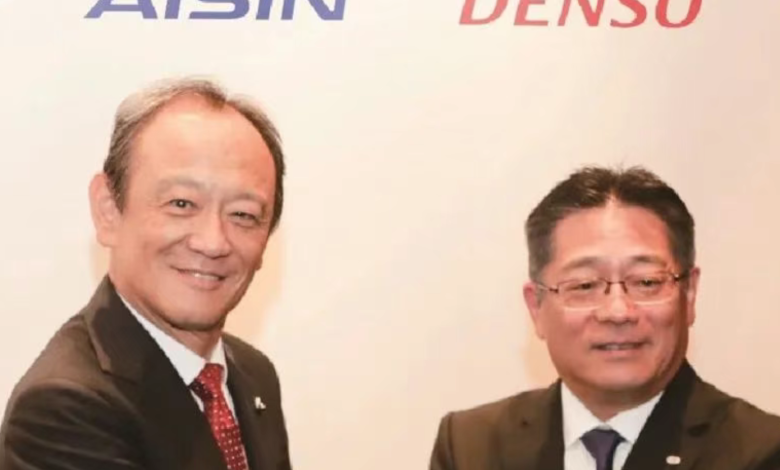
In 2019, Aisin and Denso co-founded BluE Nexus, focusing on electric drive modules. This positions Aisin to remain indispensable even as the world pivots toward electrification.
Aisin and Toyota: A Symbiotic Relationship
Aisin is often described as Toyota’s “right arm.” Toyota relies heavily on Aisin for transmissions, hybrid systems, and even hydrogen fuel cell components. In return, Aisin benefits from Toyota’s global scale, stability, and long-term planning.
However, Aisin is not merely a captive supplier. Its client base is global, ranging from Chrysler minivans in North America to Volvo SUVs in Europe. This dual strategy—deep integration with Toyota while maintaining broad external customers—secures Aisin’s independence and resilience.
Personal Take: Lessons from Aisin for Today’s Automakers
What I admire about Aisin is its quiet strength. Unlike flashy tech startups or bold disruptors, Aisin never makes headlines for hype. Instead, it invests in incremental, reliable innovation. For automakers in China and beyond, this holds a valuable lesson:
- Focus on strengths: Aisin didn’t try to be everything—it doubled down on drivetrains.
- Adapt but don’t overreact: From sewing machines to EV gearboxes, Aisin evolves with the market but always on its own terms.
- Partnerships matter: Collaborating with Bosch, BorgWarner, Denso, and Toyota ensured Aisin learned globally while innovating locally.
For Chinese automakers often caught in “involution” (内卷)—competing in every possible segment—Aisin’s approach is refreshing. Build dominance in one domain, then expand strategically.
Beyond Transmissions: A Symbol of Japanese Industry
Aisin embodies the Japanese industrial ethos: precision, reliability, humility, and steady growth. It doesn’t seek the limelight, but its impact is everywhere—from family sedans to luxury SUVs, from hybrids to EVs.
In many ways, studying Aisin is studying the backbone of Toyota, and by extension, the strength of Japan’s automotive industry. As the auto world shifts to electrification and digitalization, Aisin’s adaptability suggests it will remain a critical player in the decades ahead.
Conclusion
So, what does Aisin make? More than just transmissions—it makes reliability, trust, and the invisible systems that keep global cars moving. From its wartime origins to its dominance in automatics, from hybrid drives to EV futures, Aisin represents a blueprint for sustainable industrial success.
For those of us watching the automotive world, Aisin is a reminder that true power doesn’t always roar. Sometimes, it shifts gears smoothly in the background, carrying giants like Toyota—and much of the world’s mobility—forward.